How LED Displays Function & Why Our Screens Outperform Competitors

How LED Displays Work: Breakdown of Structure, Light Emission & Application Scenarios
Meta Description: Discover the internal working logic of LED screens, key component roles, brightness & color control. Shop durable indoor, outdoor & custom LED displays from our factory.
If you’ve seen bright advertising billboards along highways, seamless video walls in corporate lobbies, or vibrant stage backdrop screens at concerts, you’re looking at LED displays. Unlike passive display technologies such as LCD that rely on backlights, LED panels create images through self-emitting diode chips. Many business buyers only care about price and size, yet understanding how LED displays operate helps you pick a stable, long-lasting screen matching your project needs.If you’re ready to source high-quality factory-direct LED panels for commercial deployment, check our full lineup: Our LED Display Collection
1. The Basic Light Emission Logic of Single LED Pixels
Every full-color LED display pixel holds three tiny light-emitting diodes: red, green, blue (RGB). Each diode lights up independently when electric current passes through its chip.
Low current = dim light output
High current = maximum brightness
By mixing different brightness levels of the three base colors, one pixel can generate thousands of hues. Thousands/millions of these RGB pixels arranged in a tight grid form the complete viewing surface of the screen.
Monochrome screens only use one diode (mostly red) for text notifications, while dual-color (red+green) suits simple text and basic graphic signage. Our high-definition RGB full-color LED screens use premium grade A lamp beads for precise color blending without color fading after years of use.

2. Step-by-Step Signal Transmission Workflow
The whole system runs on a complete signal delivery chain, split into 5 clear stages:
Signal Source Input: Laptops, media players, cameras, or video processors send video/image data as digital signals
Sending Card Data Conversion: The sending card (core control hub) compresses, resizes and synchronizes signal data to match the screen’s resolution
Cable Data Transfer: Network cables or flat ribbon wires carry processed data to receiving cards mounted inside each screen cabinet
Receiving Card Pixel Control: Each receiving card distributes brightness/color instructions to every LED module under its management
Pixel Light Output: Modules execute commands, and combined pixel light forms the visible picture or video
A weak control system causes flickering, lagging videos or uneven brightness. All our display sets come with stable Nova or Kystar control systems pre-installed, no extra configuration hassle for install teams.

3. Breakdown of Critical Hardware Components
3.1 LED Modules
Modules act as the building blocks. A PCB board soldered with rows of RGB lamp beads makes one module. They are designed for plug-and-play splicing—you can assemble any screen dimension from small retail shop signs to huge stadium walls. Damaged single modules can be swapped separately instead of replacing the whole screen, slashing maintenance costs. We supply standalone replacement LED modules for after-project maintenance.

3.2 Power Supply Units
Industrial switching power supplies deliver steady DC voltage to modules and control cards. Fluctuating voltage burns lamp beads quickly. Our outdoor screen models adopt rainproof power supplies built for 24/7 nonstop operation.

3.3 Metal Cabinets
Cabinets frame and protect internal hardware. Two mainstream types:
Indoor thin cabinets: Lightweight, slim design for wall-mounted video walls
Outdoor IP65 waterproof cabinets: Sealed structure with dust, rain and UV resistance for roadside billboards
Our weatherproof enclosures are standard for all outdoor LED billboard products, tested against heavy rain and extreme high/low temperatures.

3.4 Heat Dissipation System
Long-hour lighting generates heat, which shortens lamp bead lifespan. Indoor screens use passive heat sinks; large outdoor units add silent cooling fans. Proper heat design lets our screens hit a rated lifespan of 100,000 working hours.
4. Key Technical Metrics That Shape Display Quality
Pixel Pitch
Pixel pitch (mm value) means the gap between two adjacent pixel centers:
Small pitch (P1.2–P2.5): For close-view indoor spaces (meeting rooms, showroom video walls)
Medium pitch (P3–P6): Retail stores, hotel lobbies
Large pitch (P8–P20): Distant-view outdoor highway ads, stadium perimeter screens
We offer a full range of fine pitch indoor panels and large pitch outdoor screens to fit every viewing distance demand. View our fine pitch indoor LED video walls for high-end office and exhibition projects.
Refresh Rate & Grayscale
High refresh rate (≥3840Hz): No flicker when filmed by phones/cameras, essential for live broadcast events
High grayscale level: Delicate gradient colors for movies and promotional footage
Cheap low-end screens cut costs by lowering refresh and grayscale; our factory maintains high specs as standard for all commercial-grade products.
Brightness Tuning
Indoor screens run at 300–800 nits to avoid eye strain; outdoor screens need 4500–10000 nits to fight direct sunlight washout. Most of our outdoor models support auto-brightness adjustment via light sensors to save power at night.
5. Special LED Display Variants & Unique Working Adjustments
Not all LED screens follow the exact same assembly design—specialized types have modified structures:
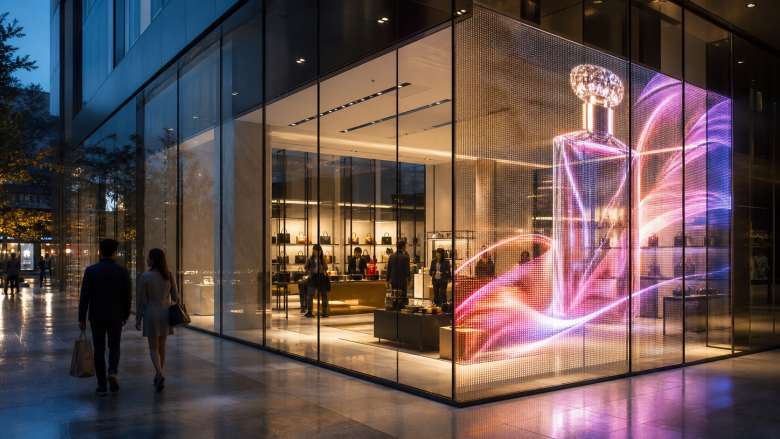
Transparent LED Screens: Hollow module structure lets light pass through gaps, ideal for glass mall facades; light emission logic stays RGB but with optimized pixel layout
Curved LED Displays: Flexible PCB modules allow concave/convex bending; control cards are calibrated to correct image distortion on curved surfaces
Portable Stage LED Screens: Quick-lock cabinet frames for fast assembly and tear-down for rental events
We provide one-stop custom LED display solutions, including transparent, curved, rental and flexible shaped screens tailored to your project drawings.
6. LED Display vs LCD & Projector: Why LED Technology Dominates Commercial Use
FAQ Section
Q1: Can I run my LED screen 24 hours a day nonstop?
A: Our industrial-grade LED displays support round-the-clock operation with proper heat dissipation. For continuous use, we recommend scheduling quarterly basic inspections of power supplies and cables.
Q2: How long will it take to install a full LED screen system?
A: Small indoor screens (2–5 sqm) take half a day; large outdoor billboards require 1–3 days with professional installation crews. We send detailed installation manuals and offer remote technical guidance for global buyers.
Q3: Are spare parts easy to source after purchase?
A: We stock full spare parts (modules, power supplies, receiving cards) for all our models, with fast global shipping to reduce project downtime.
Conclusion & Call to Action
Understanding how LED displays work empowers you to avoid inferior products with shoddy lamp beads or unstable control systems. Whether you need an indoor corporate video wall, outdoor advertising billboard, stage rental screen or bespoke transparent facade display, our factory delivers ISO, CE, FCC certified LED products with competitive wholesale prices and long-term after-sales support.
Explore our full product catalog: All LED Display Products
Send your project size, location and budget for a free customized quotation: Contact Our Sales Team


Comments